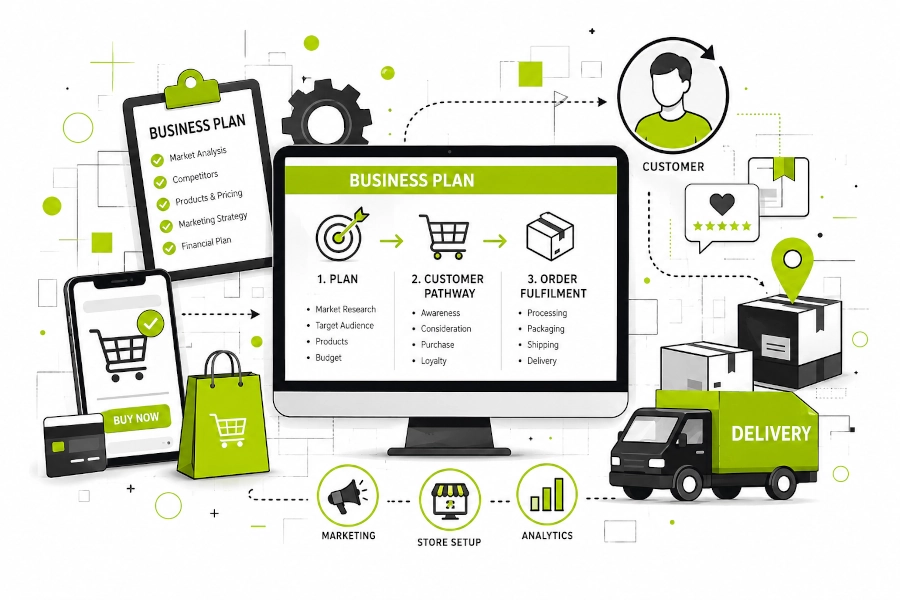
In our guide to setting up an e-commerce business we are going to take you through some of the things that you will need to consider. Running a successful ecommerce business requires thoughtful planning across several operational, financial, and technical areas. From choosing the right platform to designing pricing strategies, managing logistics, and ensuring customer satisfaction, every decision you make while setting up your online store will determine your long-term success.
1. Choosing the right product niche
This is probably the one thing that is going to have the biggest impact on your route to success. It can also determine how much it’s going to cost in marketing, impose cashflow restrictions, Customer Service overheards, returns policy etc…
Competition
If you pick a common product area, e.g. TVs, you are going to have an uphill struggle right from the start as you will need to compete in an oversaturated market against some large and well established brands. Taking the TV example, just consider how much money companys like Currys has for online marketing and whether you would be able to compete against them. Additionally TVs are easily available on common market places like Amazon. So unless you have a unique product and have negotiated or have control of geographic distribution you will find it very difficult to make an in road without very deep pockets.
So choose wisely. Preferably chose an area with limited competition, for example a nascent product area and/or negotiate some exclusive rights of sale in your geographic region for a known diserable product.
Assesing the level of competition you will face for your chosen products is going to determine if you can break through. Research who the biggest online competition would be for your products and try and avoid saturated markets.
Price Point
How much a product costs and its size/weight also have a big impact on the feasibility of your e-commerce store. High value products will suck up cash flow when buying stock. The impact of this can be reduced by using a dropshipping model. But even this, when you start out depending upon whether there is a delay in your access to funds can mean that your cashflow can limit your ability to deliver products in a sensible time frame.
More expensive product are also harder to sell, you need to have stronger trust signals on your website to give confidence to customers making a purchase of a high ticket item. The advantage of higher ticket items is that the absolute value of your profit margin is larger.
With less expensive products you can generally afford to hold more stock which benefits order fulfillment times. But generally speaking you have to then make a lot of sales to make any substantial profits.
The best solution is to provide a range of products some high ticket and some low ticket items.
Size
This may seem an odd one but big things require more space for storage, come with handling issues and are more expensive to ship. Shipping heavy low cost items is the worst as you end up spending a lot on shipping for low returns. Therefore shipping heavier low cost item can eat into your profit margins, which for low cost items can be significant. If you are holding stock you will also be paying this disproportionate shipping cost purchasing it from the manufacturer. If the manufacturer is international, say China, then things can get quite expensive quite quickly.
Also think about how you are going to handle the items once you get them. Are you able to store them, would you need a pallet truck to move them around etc.. Big/heavy things are harder to handle and will increase your costs per item.
2. Your Marketing strategy
So we are going to jump in quite quickly with marketing. The trap people fall into is that they can assume that once your build an e-commerce website people wll come. Of course that is not the case. One of the first things you want to do is decide if you have a marketing budget, and if so what is it.
Sales Channels
Ultimately your goal is to generate organic and direct traffic. This is unpaid site visitors that come from online searches or from customers that visit your site directly that know about the store from word of mouth or are repeat visitors. The clue as to why you want to increase the proportion of traffic you get from these sources is in the word unpaid. this is traffic that you are not paying for. There is no additional cost to getting these traffic events.
Unfortunately there tends to be a lot of work to do before you get there.
Key channels
- SEO: Get found on Google for free
- PPC Advertising: Google Ads, Facebook/Instagram, Tik Tok
- Email Marketing: Automated campaigns, abandoned cart emails
- Social Media: Inbound Marketing
- Influencer: Product reviews and partnerships
Of the key channels PPC advertising is generally the most expensive but it can also be the most rewarding if set up correctly. For one reason it is a very important tool in any SEO stratgey as it gathers some great information for keyword optimisation for your SEO strategy. For the other reasoon is it will drive traffic to your website and with good optimisation will yield a ROI. This can be especially helpful for new websites that at the outset will recieve very little traffic.
Email Marketing can be a cheap way to run a marketing campaign. The downside is at the start you wont have any emails. but it is very important that you start building an email list as they will pay dividends later.
Social media is also a free way to drive inbound traffic. Generate content on your site and then post links back to that content using your socials. You can of course run advertising campaigns, which depending upon your product niche and the socials you choose can be very effective. But building a brand voice on your socials and then initiating campaigns with targeted posts to content on the site is also a very good tool to raise brand awareness.
Marketing Tips
- Build an Email List
- Stay focused on a few marketing channels instead of everything at once
- Track your results and then invest in what works
3. Order Fulfillment
So you have chosen a product, you have thought about how you are going to market that product and drive sales. The next thing to consider is if you get an order how are you going to fulfill it?
Part of the answer to this question will depend on who you are getting the product from, what space you have to manage stock and cash flow. The easiest way to start selling online is to use a dropshipping model.
Dropshipping vs. Holding Your Own Stock
So firstly, what is dropshipping? Dropshipping is where your supplier ships your order directly. So your website takes the order. You then purchase those items from your supplier and pass on your customers details. The supplier will then ship the order directly to your customer. Dropshipping means that you do not hold any stock.
Many new e-commerce businesses consider dropshipping to reduce risk. Both approaches have pros and cons.
| Dropshipping | Holding Stock | |
|---|---|---|
| Pros | – No need to invest in inventory – Storage not required. – Easy to test new products. – reduces cash flow issues | – Full control over product quality and fulfilment – Faster Shipping – Higher margins |
| Cons | – Lower margins. – Less control over shipping speed and quality. – Stock availability can fluctuate unexpectedly. | – Requires storage space. – Higher upfront investment and risk. – Can result in cash flow issues |
Key considerations
If you go down the stock route then the main things you have to consider are tying up money in stock, tracking stock and how to ensure you can replenish in time.
Most e-commerce systems have stock tracking incorporated which you can use to track stock. However you may want to integrate that with a warehouse tracking system. Automating stock management is very much the way to go. manual stock management does not scale very well and often leads your e-commerce site and your “warehouse” being out of sync.
You also want to determine what your supplier lead times are and combine that with analysis of stock demand to determine minimum stock level alerts etc..
If you choose dropshipping then you do need to spend some time looking at the reliability of your suppliers. You need to communicate with your customers about shipping as clearly as possible to manage expectation. The other thing to consider is how you can brand your shipment. You maybe able to arrange the dropshipper to include packing slips for example. Lastly what happens if a customer does not receive their order or the order arrives damaged. Your customer’s contract is with you not the dropshipper so you will need to consider their terms and conditions very carefully inorder to determine how you manage returns and order cancellations.
The other way is to use a hybrid model. Dropship low-volume experimental products, stock the proven sellers.
4. Shipping
So if you have decided that you are going to ship directly to the customer shipping is extremely important for two reasons. Firstly it has a significant impact on customer experience. People expect fast, hassle free order delivery with good communication. Secondly, shipping can impact your profit margins especially for cheaper but heavier items. And customers don not like to spend a lot of money on shipping.
- Shipping Company Selection: You want high delivery success rates with no damage at fast speed. This can be difficult to get. There are always trade-offs. Orders that arrive damaged or not at all cause extra support tickets and extra costs. Also you must have some sort of Proof of Delivery tracking as a minimum. And lastly, what provision do they provide to manage return labels easily
- Packaging: This is again another additional cost. You will want to be as minimal a possible but also ensuring that your customers orders do not arrive damaged.
- Shipping Strategy: So commonly this is Flat rate, Free (essentially taken into account when pricing the product) or some sort of weight based shipping model or similar. Flat rate is easy (people do expect to pay a shipping cost) but it needs to be attractive whilst not cutting into your margins too much if the courier cost is high for a order.
- International shipping: his comes with its own headaches of customs tariffs and local taxes. How you approach this will depend in part on where abouts you are shipping to and the country of origin for the product.
Its best to start out by testing some different couriers. You may also find it difficult to negotiate on rates when you start as you don’t know what your shipping volumes are going to be.
You can also offer multiple shipping options. This might be with the same courier (e.g. 1st and 2nd class delivery) or using different couriers. so if you have weight based shipping option configured you may want to use a different courier for heavier items. How easy it is to implement this will depend on your chosen e-commerce system.
And use your courier to simplify your returns process as much as possible for your customers.
5. Pricing Strategy
Pricing is one of the hardest things to get right. you have 3 things to deal with which are the actual cost of the product and order fulfilment, Your competitor’s pricing and what your customer’s are willing to pay for you product. Setting your prices isn’t just about adding a margin to your costs. What price you should sell at is constrained by the market. The other thing to consider is with the range of margin that is available to you do you go for selling more at lower margins as opposed to selling fewer at higher margins. In general you want to chase more orders. You must consider market expectations, costs, and perceived value.
Key considerations
- Cost structure: Take into account all costs. Product cost, shipping, packaging, transaction fees, marketing, returns.
- Competitor pricing: Research your competitors prices but avoid a race to the bottom.
- Customer behaviour: Understanding what your target market will pay is difficult, try experimentation and tricks like e.g., €29.99 vs. €30.
- Dynamic pricing: Don’t forget to adjusting prices based on demand, seasonality, or stock.
It is best to do a full cost breakdown. remember to include everything. The trick is DO NOT UNDERESTIMATE YOUR COSTS. Also review your pricing regularly. Your costs will change over time. Also the general market will change over time. New competitors appear, new products appear and new manufacturers appear.
6. Choosing the Right Website Platform (CMS / E-Commerce Platform)
So for an e-commerce business your shop front is your website. Whilst you may be focused on what your website looks like the key consideration when choosing your e-commerce platform is functionality, ease of use, cost and integration into your workflow.
Some of the main players are self hosted platforms like WordPress/Woocommerce, Magento, Prestashop, Opencart and proprietary hosted solutions like Shopify, Bigcommerce, Wix ecommerce. They each have their pros and cons.

The big difference between the self hosted and proprietary solutions is that with self hosted you own all your data and have more versatility. In general the costs will also be cheaper as most proprietary solutions have costs that mount up quite quickly until your monthly subscriptions can be quite high.
Key considerations
- Ease of use: Proprietary solutions are generally the fastest to set up but customisation can be very limited
- Scalability: Look to the future and think about how usable the platform will be as the business grows. This will also effect costs for Proprietary platforms
- Features: ecommerce platforms will come with a native range of features and additional add on modules to add extra features. Decide what features you need now and in the future. For some platforms 3rd party plugins can add more expense
- Integrations: how easy is it to integrate your store with other software platforms e.g. CRM, Accounting software. Does it have a mature API
- Ease of Development: how easy is it to develop additional functionality and design requirements. If it is hard it can increase costs or limit functional enhancement.
- Hosting & Performance: Proprietary systems come with hosting. Self hosted platforms require an additional hosting plan that can be expensive for Magento in particular. But with self hosted you do have more control over performance if it is your own server.
So Start by thinking about a clear set of features you will require. Think about your products and identify a platform that will allow you to structure your products and catalogue in a way that will suite its market. And try and think long term. It adds extra expense if you switch platforms and with proprietary platforms it can be difficult to export all your data.
If you have questions about which ecommerce website platform is best for your business then please get in touch. We can offer advice on what features each platform has and what the pitfalls that you will encounter with each one. Remember each has there pros and cons. its about identify which one is best suited for you.
7. Branding & User Experience (UX)
Whilst website design, the look and feel of your website to visitors is very important it is not as important as your offering as a business i.e. your products and customer service. What it impacts is your likelihood of a conversion. Your website needs to be visually appealing, easy to use, and trustworthy.
Often the mistake business owners make is to always just look at the website from their perspective, what they like, how they navigate around websites. But people are all different. It may be that your target audience represents a different demographic to yourself e.g. you need to market to older people, younger people, males, females, red, blue, green or yellow personality types. They will have different perceptions of what “looks good” and will navigate around site differently. There is no point having a cooperate looking website if you are selling artisan products for example or vica versa.
Key considerations
- Brand identity: Think about your Brand’s voice, use brand identity indicators: logos, colours, fonts
- Mobile friendly design: Ensure the design is responsive. But do think about what devices your customers are going to be mostly using.
- Navigation: How are people finding the product they need. Different people do this differently so make it easy via links, browsing and search.
- Trust signal: Make trust signals prominent. Reviews, secure badges, returns policy, industry related memberships.
So the general rule of thumb is keep things simple. Don’t bombard your visitors with Pop-ups and the like. Keeps things clear and signpost. What you are trying to do is make is simple, in a few clicks, for a visitor to find what they are after and purchase it. And whilst they are doing that you want to present a brand so that that visitor will remember it was your website.
With products people like to know what they are getting so you need to provide as much information as you can to allow them to make up their mind. It gives the potential purchaser confidence that they know what they are buying. Use high quality pictures so they can visually inspect what they are getting and images from more than one angle.
Its all about instilling confidence in your visitors.
8. Payment Gateways & Security
So for an e-commerce platform to function properly you need a means by which customers can pay for goods. Generally speaking you will need to use a payment gateway that will accept card payments or a wallet solution like Paypal, Apple Pay or Google Pay. If you deal mainly with B2B you may consider having clients pay on account and provide bank details for BACS transfers.
The general rule of thumb is to offer several different solutions. Customers are different and people will prefer different payment gateways. For example just offering Paypal can put people off if they want to pay by card even though its possible to do this with Paypal whereas others will like the security of Paypal. You may also want to offer deferred payment options like klarna. The best option is to offer lots of different options.
Key considerations
- Offer multiple payment options: Credit cards, Paypal, Google Pay, Apple Pay, Klarna etc..
- Ensure you are PCI Compliant: Generally it is best not to use self hosted options
- Fraud protection: What tools does the payment gateway have to protect you against fraud e.g. 3DS.
Ultimately your main goal when choosing a payment gateway is to reduce checkout friction and ensure that your payment solutions are secure. You may also want to consider cash flow. When starting out for some e-commerce ventures cash may be tight so having money sitting in a clearing account for several days may impact your ability to buy stock or pay the drop shipper.
9. Customer Service & Communication
So the two things about customer support is that firstly it is essential for customer retention and reputation and secondly it can take up a lot of time especially if things go wrong.
So first and foremost you should provide as much information about your products as possible and provide clear information about your business and how ordering and shipping etc works so that vistors can find most information out by themselves. A lot of thing customers want to know boil down to “will it fit” or “is it going to work with X” or “will it do X”. So you should aim to answer these questions on your product pages are clearly signpost pages where they can find that information. You need to anticipate what your customer’s questions will be.
Secondly provide a post order pathway of communications about the state of their order. And order confirmation email > Shipping notification as a basic. hat way you limit the most common customer support contacts of “When will I get my order” or “has my order been shipped”.
If you do the above two well that will remove most of your customer queries.
But obviously you will get customers queries that will not be resolved by the above so you need to offer a means by which customers can get in touch. The bear minimum is an email contact form. Additionally offer an on-site chat and/or phone number. If you are going to offer a chat functionality then it needs to be covered by a member of staff otherwise people will be annoyed. The same with the phone. So both offering Chat and a telephone number come with their own time overheads, someone has to be on-call. So do consider that before you implement them. But certainly people do like to be able to ring and speak to someone so if you can offer telephone support along with email support that is a winner.
Key considerations
Mainly you want to respond quickly. Often people will be getting in touch whilst on your site prior to the purchase themselves so if you can respond quickly you will more than likely secure these sales.
Always be friendly regardless of how poor your customer’s behaviour is. Make sure your communications are clear and manage expectations. There is no point in lying to a customer about when they will get their order etc… as when it doesn’t turn up when you say it will they will be more annoyed. Being transparent about things works best.
10. Legal & Compliance
As with all business you will have red tape and hoops to jump through. Be aware of distance selling regulations and data protection. You can write what you want in your terms and conditions but it does not mean anything as your business is governed buy the law applicable to your region, in this instance the UK.
Distance selling regulations will determine to a large extent your returns and refunds policy. For example a customer can cancel there order up to 14 days after the order is delivered for no reason. There are exceptions but generally you will need to accommodate this time frame in your returns policy.
Data protection legislation will determine your privacy policy, cookie policy and GDPR compliance.
You will also need to ensure that you are collecting the correct taxes etc.
Ideally you would employ a solicitor to write your own documentation in consultation with yourself. But if that is difficult there are plenty of templates out there. Also view a number of your competitors terms and conditions and you can then put together your own although it is still best to seek legal advice.
Making such information easily available to your visitors acts a an indicator of trust to your visitors and also to search engines.
Final Thoughts
Building a successful e-commerce business incorporates many different components. It is about balancing between the needs of the business and the needs of the customer. Your main goal is to make money but the only way to do that is to provide an affordable and efficient journey to your customers and one which is better than your competitors.
But the way you operate will change as your business and brand evolves. Don’t stay static and do the things that work and drop the things that don’t.
But ultimately if you think about the different components we have outlined above and plan out how you are going to address them it will make your business more likely to succeed and reduce the time you spend and hopefully reduce the stress.
We have been helping people develop e-commerce businesses for many years now so if you have any questions please feel free to get in touch and ask we are happy to help where we can.
Good luck.